1.9. Control Systems#
A control system reads sensor values and commands actuators so that a mechatronic device can perform its tasks. In a modern mechatronic system with a microcontroller, the control system is often implemented in software.
In many mechatronic systems, this is done using a loop that repeatedly reads inputs, makes decisions, and updates outputs.
There are two broad categories of control systems:
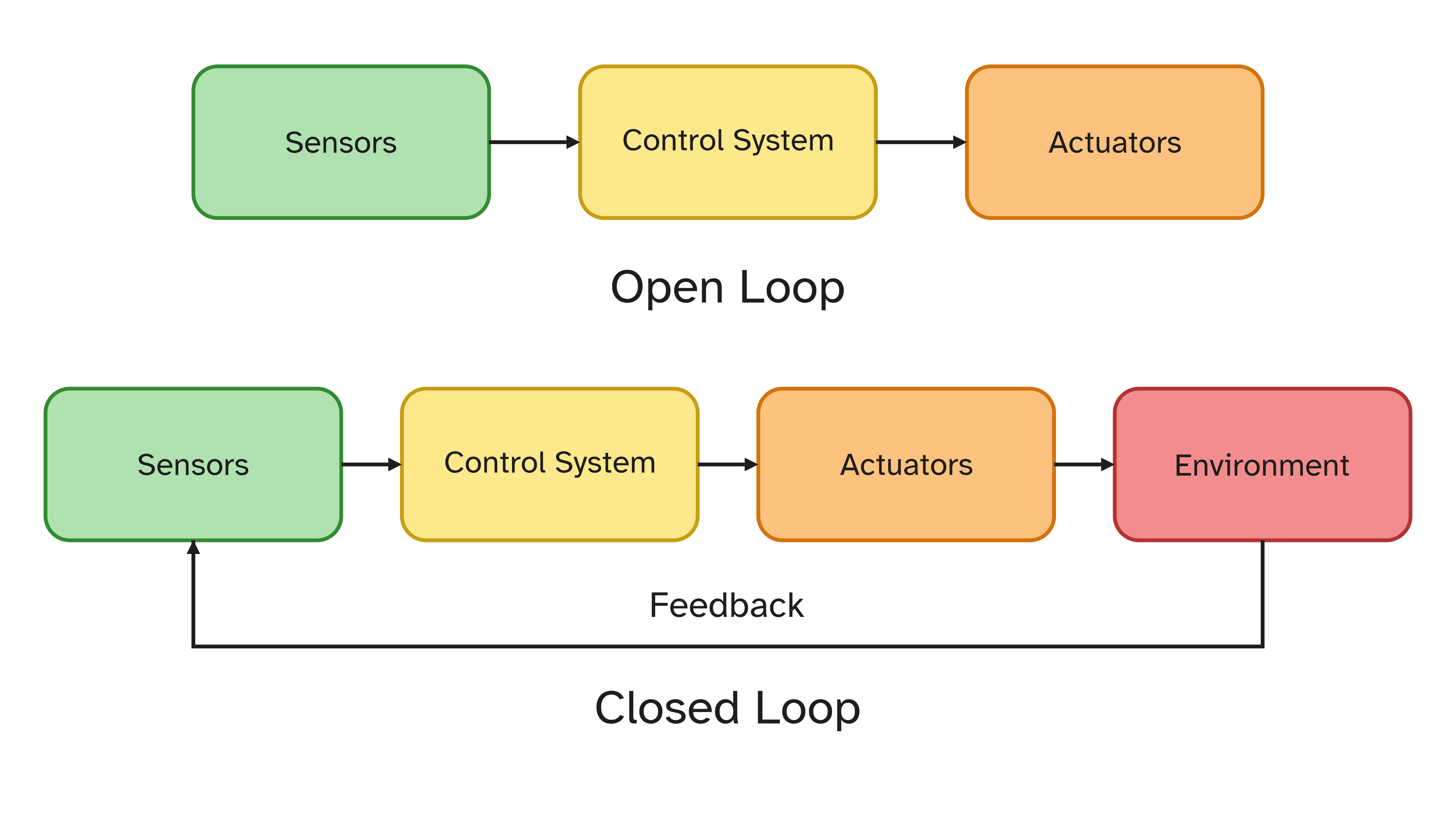
Open loop - the controller acts without checking whether the desired result has been reached.
Closed loop - the controller uses feedback from sensors to adjust its actions.
For example, we can compare a toaster and an oven. A toaster powers the heating elements for a fixed amount of time set by the browning dial. It does not measure how brown the toast is, so it cannot adjust the cooking time based on the actual result. Therefore, a basic toaster uses open-loop control.
An oven uses a temperature sensor to measure the actual temperature. If the oven is below the target temperature, the controller turns the heating elements on. If the oven reaches or rises above the target temperature, the controller turns the heating elements off. Therefore, an oven uses closed-loop control.
Within closed-loop control there are many different control schemes, which we will discuss in more detail later.
1.9.1. Example: Washing Machine#
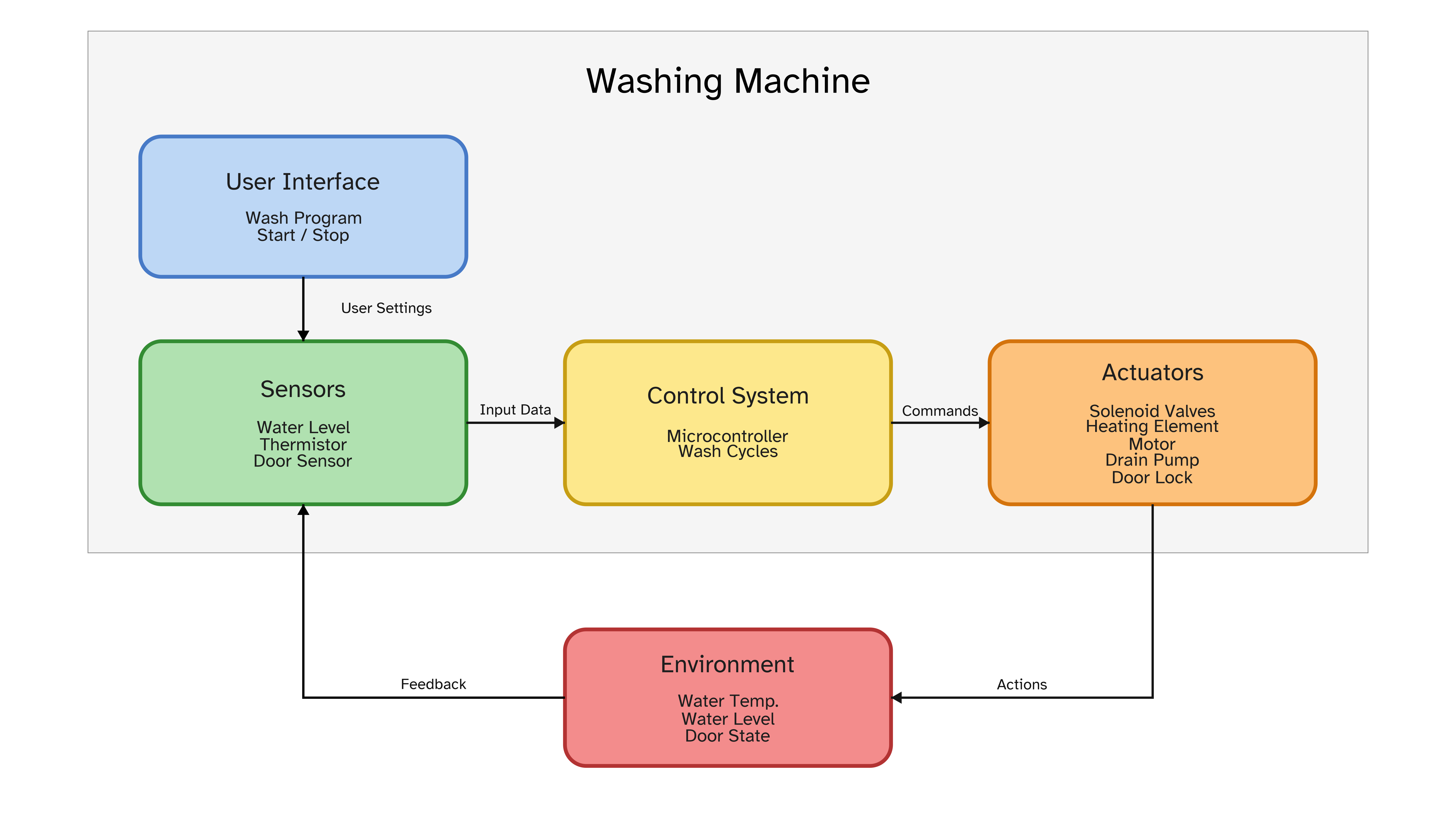
As an example, let’s consider how a washing machine controls a wash cycle.
Sensors
Water-level switch tells the controller when the tub is full enough.
Thermistor reports the actual water temperature.
Door sensor checks whether the door is closed.
Actuators
Solenoid valves open to let hot or cold water in.
Heating element raises the water temperature.
Motor rotates the drum slowly for washing and quickly for spin drying.
Drain pump empties the tub.
Door lock solenoid locks the door during operation.
Control System
A microcontroller waits for the user to select a wash program and press start. It then moves through a sequence of stages, such as filling, washing, heating, draining and spinning.
Some parts of the wash cycle are controlled as a sequence. Other parts use feedback. For example, the controller can use the water-level switch to stop filling when the tub is full enough, or use the thermistor to stop heating when the target temperature is reached.